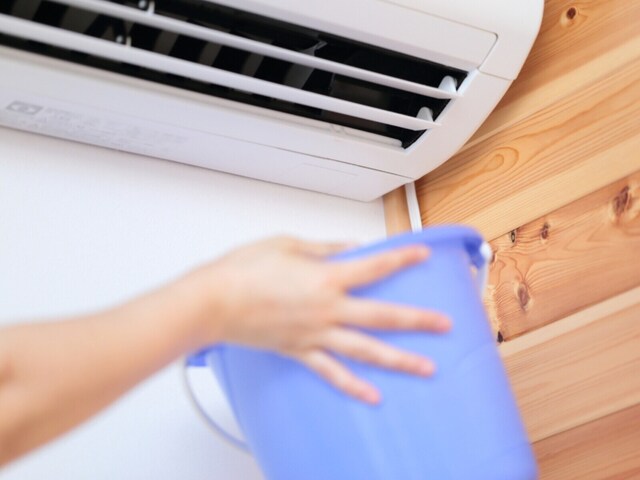
Immediately after switching off the air conditioner, water may fall from the outlet with a "drip, drip" sound.
You may be surprised when you see it for the first time, but the phenomenon of a small amount of water dripping right after stopping is, in most cases, evidence that the air conditioner is operating normally.
The cause of water dripping right after stopping is "condensation."
It is simply that the condensed water remaining inside the air conditioner is not drained because the fan has stopped, and it falls down as is; it is not a malfunction of the device.
While the air conditioner is in cooling or dehumidifying operation, the surface of the heat exchanger (aluminum fins) inside the indoor unit is cooled to about 5 to 15°C.
When the warm, humid indoor air comes into contact with these cold fins, the water vapor in the air turns into condensation, and this is how dehumidification is performed.
During operation, the condensed water that collects in the drain pan (the tray placed under the heat exchanger) is continuously drained outside through the drain hose.
However, when the air conditioner stops operating, the blower fan also stops at the same time.
As a result, the condensed water that had adhered to the heat exchanger, fins, and surrounding inner walls drips down as is before it can flow into the drain hose.
Also, there are cases where water droplets remaining in the outlet fall.
In either case, there is no problem if it naturally stops within 23 minutes after the cooling operation is stopped.
If it only drips a small amount immediately after stopping, there is no problem, but in cases like the following, measures are necessary.
A clogged drain hose is suspected.
If dust, insects, or algae accumulate inside the hose, water may overflow from the drain pan and leak into the room.
This can often be resolved with a commercially available drain cleaning spray, and if it still does not improve, consider requesting an air conditioner cleaning service.
There is a possibility that air is not supplied normally due to a clogged filter, causing the heat exchanger to cool too much and frost to form.
In this case, a large amount of water may come out when the frost melts.
After cleaning the filter, check again to see if water still comes out.